
Back to the Table
Breaking bread for the sake of health

“When we gather with others around food, we not only feed our bodies but also nourish our spirits.” — Vivek Murthy, U.S. Surgeon General
In 2023, U.S. Surgeon General Vivek Murthy proclaimed the latest malady plaguing people across the country—the loneliness epidemic. In recent years, nearly half of U.S. adults reported experiencing loneliness, and there is evidence to support that other countries are experiencing the issue as well1. It doesn’t take much reflection on Americans’ time use to come up with the reasons why people are lonelier now than they have ever been. In 2024, the average American spent approximately two-and-a-half hours per day watching TV compared to approximately half an hour of socializing2. The good news is that there’s a relatively simple solution to reducing loneliness: eating meals together. The bad news is that we are doing this less than we ever have before.
As of 2023, approximately 1 in 4 Americans reported eating all of their meals alone the previous day—an increase of 53% since 20033. According to Jan-Emmanuel De Neve, an author of the World Happiness Report, which includes a chapter titled, “Sharing meals with others: How sharing meals supports happiness and social connections,” smartphones and social media are exacerbating the problem, but there isn’t a single cause4. The ubiquity of solo dining options (e.g., meal delivery, fast casual dining) and the rising share of people living alone (nearly 30% compared to ~8% in 1940) are additional factors isolating individuals at mealtime5. This is problematic not because eating alone clearly causes health problems. Rather, eating meals alone is leaving improved well-being on the table (no pun intended).
The 2025 World Happiness Report highlights the following links between shared meals and well-being
Meal sharing is a strong predictor of subjective well-being. Across 142 countries, individuals who share more meals report significantly higher life evaluations, higher positive affect, and lower negative affect.
The positive relationship is nearly dose-dependent. Life evaluations rise steadily with each additional shared meal per week. Individuals who shared zero meals reported the lowest average life evaluations with the score steadily rising for each meal shared until nearly every meal in a given week was eaten with others.
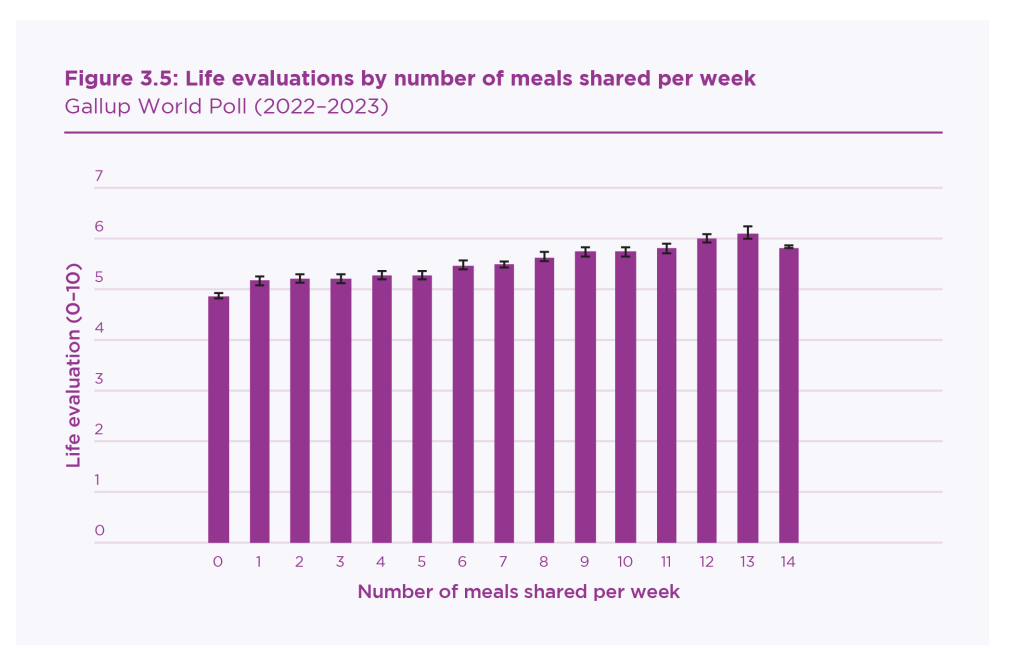
Figure 1: Life evaluations by number of meals shared per week, 2025 World Happiness Report
Shared meals outperform income and unemployment as indicators of well-being. Regression analyses show that the number of meals shared explains more variation in life evaluations and positive affect than income quintile or unemployment status.
The benefits of shared meals are strongest for young people. While shared meals are associated with higher well-being at all ages, the relationship is strongest for ages 16–24.
Food enjoyment increases measurably with shared meals.
Respondents who shared more meals reported higher enjoyment of both cooking and eating, suggesting shared meals enhance not just life evaluation, but everyday experience.

Eating together—what anthropologists call commensality—has long been understood as a foundational human practice. Research on hunter-gatherer societies shows that food sharing and communal meals were central to survival, cooperation, and social cohesion6. Anthropologist Claude Fischler argues that commensality functions as a “social glue,” signaling trust, belonging, and mutual obligation across cultures, while eating alone often marks social marginality7 . There’s also evidence to support the claim, “families that eat together stay together,” as families that eat together report stronger emotional bonds8 . Beyond scientific research, linguistic evidence provides further reinforcement: the English word companion, the French copain, and the Italian compagno all derive from the Latin cum panis—“with bread”—underscoring how deeply shared eating is embedded in the very language we use to describe closeness.
As the world drifts farther apart, perhaps it’s time to come together at the table—one meal at a time.
Stepwise strategies
Here are five simple ways to eat together more often
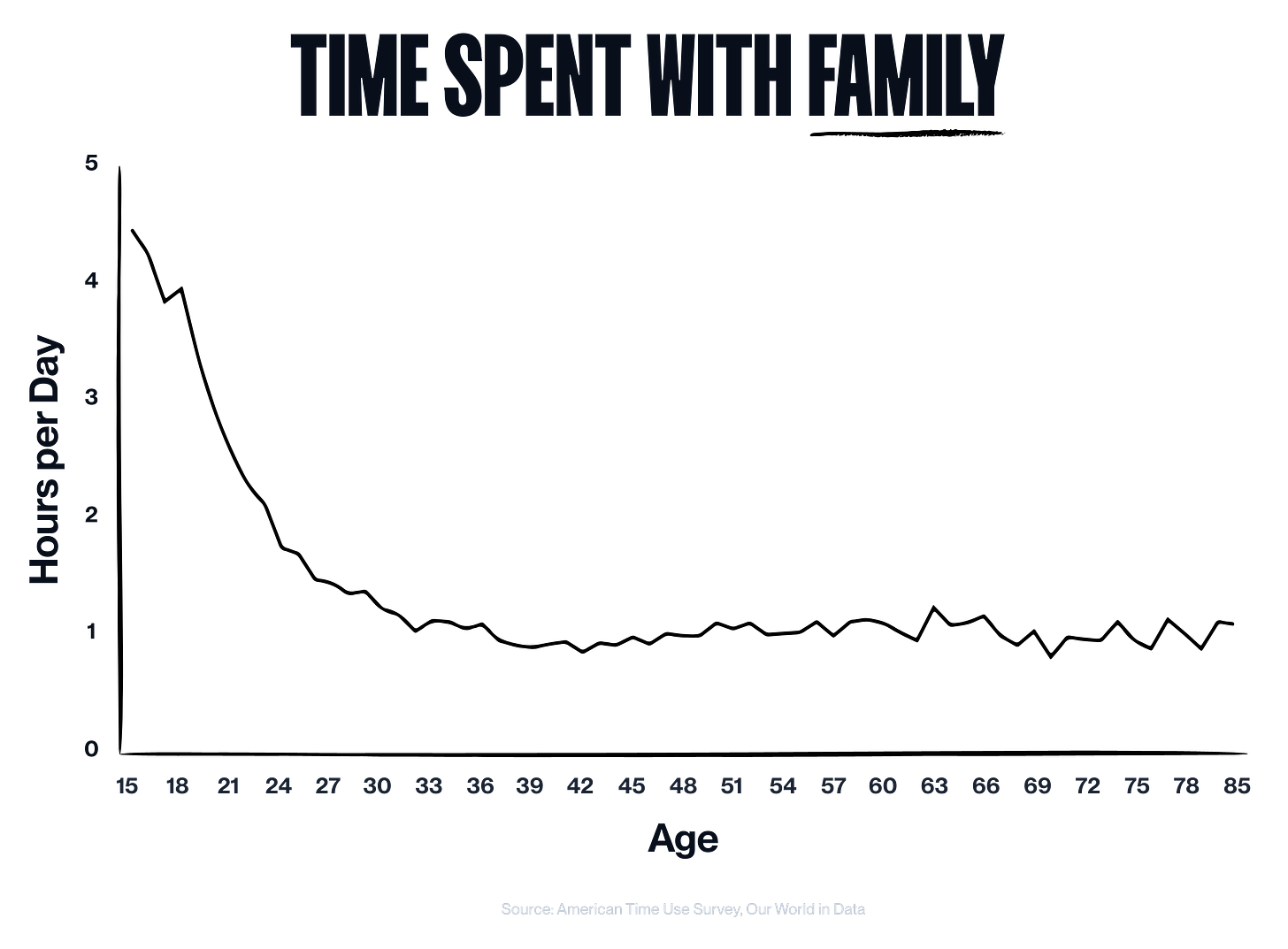
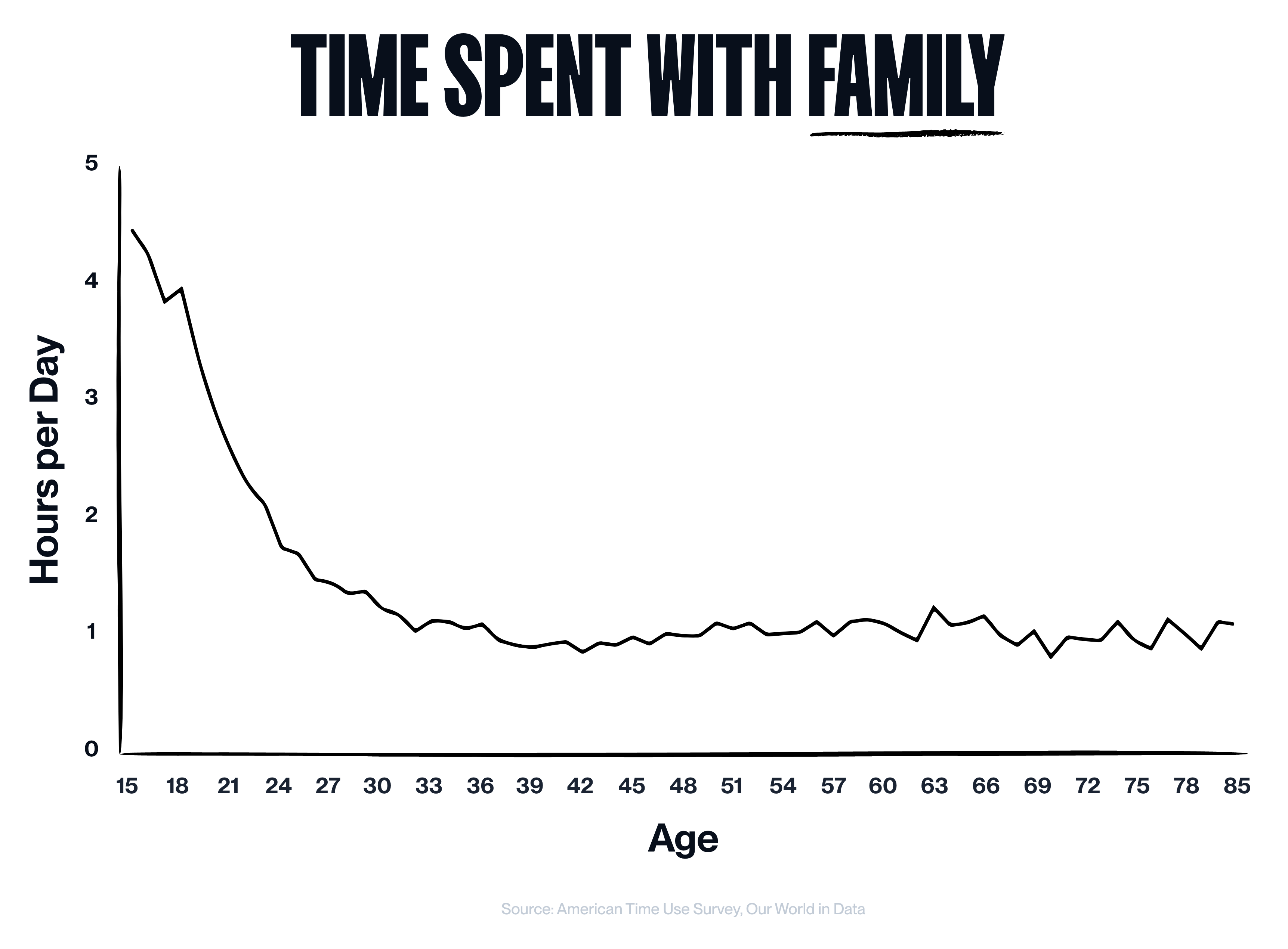
With family: Time spent with family after the age of 20 declines drastically. Even if it’s a video call and takeout dinner once a week, find time to share meals with your family—it’s later than you think.
With coworkers: As De Neve has also found in his workplace well-being research, workers quit not because of leadership alone, but because they lack a sense of belonging with their teams9. In other words, friendships at work are critical to longevity and performance. Find time away from the desk to build meaningful connections with coworkers—it will pay dividends later on.
With friends: Eating with friends is the perfect excuse to bring people together and strengthen relationships10. This sounds pretty wishy-washy, I’ll admit. However, as work and life place greater demands on our time and socializing is a less structured part of our days, it’s important to not let the muscle of socializing with friends atrophy.
With partners: In couples, more shared meals were associated with higher similarity and relationship satisfaction11. Aim to protect shared meals with your partner when possible.
Without technology: Eating while distracted (e.g., using screens or devices) is associated with lower food enjoyment and reduced awareness of the meal experience12. Try eating with your phone in a separate room or out of reach.
Next Newsletter
Book recommendations

Andrew Dugan, “Over 1 in 5 People Worldwide Feel Lonely a Lot,” Gallup, July 10, 2024. https://news.gallup.com/poll/646718/people-worldwide-feel-lonely-lot.aspx
U.S. Bureau of Labor Statistics, American Time Use Survey (ATUS), 2024
U.S. Bureau of Labor Statistics, American Time Use Survey (ATUS), 2023
Gili Malinsky, “25% of Young Americans Aged 18 to 24 Eat Every Meal Alone,” CNBC, July 14, 2025. https://www.cnbc.com/2025/07/14/25percent-of-young-americans-aged-18-to-24-eat-every-meal-alone.html
U.S. Census Bureau, “Home Alone: More Than a Quarter of All Households Have One Person,” June 8, 2023, Census.gov. https://www.census.gov/library/stories/2023/06/more-than-a-quarter-all-households-have-one-person.html
Wrangell, K. E., & Carmody, R. N. (2020). Human adaptation to the control of fire. Evolutionary Anthropology, 29(4), 219–228. https://doi.org/10.1002/evan.21824
Fischler, C. (2011). Commensality, society and culture. Social Science Information, 50(3–4), 528–548. https://doi.org/10.1177/0539018411413963
Sobal, J., & Nelson, M. K. (2003). Commensal eating patterns: A community study. Appetite, 41(2), 181–190. https://doi.org/10.1016/S0195-6663(03)00078-3
Crowley, M. C. (2025, August 11). No one has office friends anymore. Why that’s bad news for employers. Fast Company. Retrieved from https://www.fastcompany.com/91371839/why-workplace-friendships-are-fading-and-why-that-matters-to-the-bottom-line-workplace-friendships
Dunbar, R. I. M. (2017). Breaking Bread: The Functions of Social Eating. Adaptive Human Behaviour and Physiology, 3(3), 198–211. https://doi.org/10.1007/s40750-017-0061-4
Herwig et al., (2025). Two forks, one meal: Health implications of shared food systems in couples. Appetite, 183, 106119. https://doi.org/10.1016/j.appet.2025.106119
La Marra, M., Pendergast, D. M., Worsley, A., & McNaughton, S. A. (2019). The impact of eating with distraction on eating outcomes: A systematic review. Appetite, 142, 104353.